Commercial Concrete Contractor in Huntsville, AL
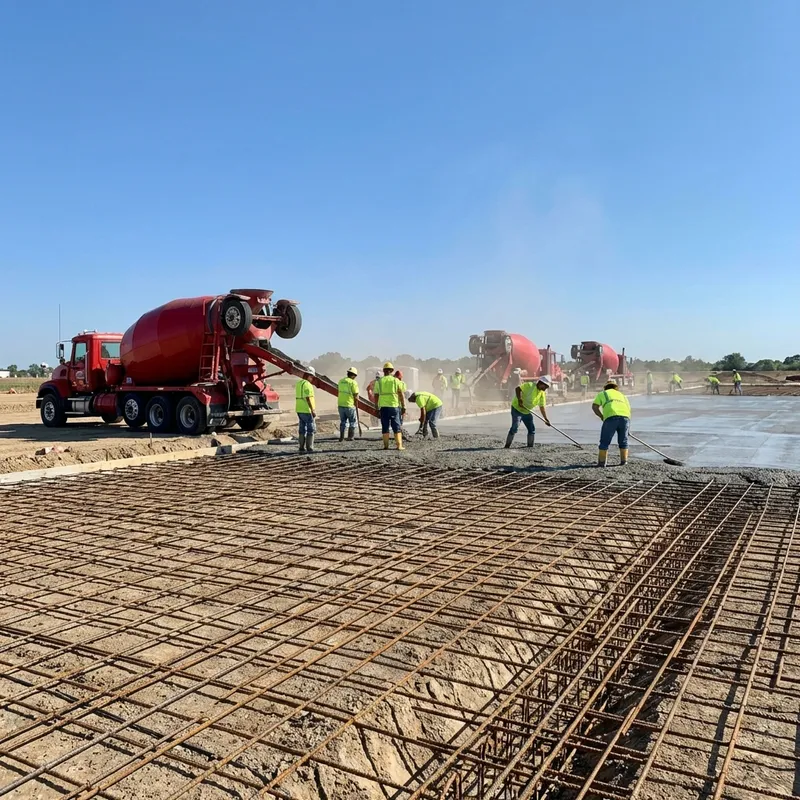
Huntsville Superior Concrete is a commercial concrete contractor in Huntsville, AL with four crews and 69 years in this valley. Warehouse and industrial floors, loading docks and truck aprons, parking lots, ADA ramps, curb and gutter, and equipment pads.
We phase pours so your site keeps operating. Send us the loading, the traffic pattern and the hours you cannot be down, and we will price the job around those constraints instead of around ours.
Commercial Concrete Services We Self-Perform
Warehouse and Industrial Floors
Placed to a defined flatness target and laser screeded on anything over roughly 5,000 square feet, because hand screeding a big floor is how you end up with a low spot nobody can drain and a rack that will not shim level. Joint layout is designed around aisles and rack lines, not dropped on as a uniform grid.
Loading Docks and Truck Aprons
The hardest-working concrete on any commercial site. Trailer landing gear concentrates enormous point loads in a small footprint, so aprons get 7 to 8 inches at 4,500 PSI with a tightened rebar grid in the landing zone. Dock pits, levelers and bumper blocks set to the equipment schedule.
Parking Lots, Curb and Gutter
Drive lanes at 7 inches, passenger bays at 5, with the truck path mapped before anything is priced. Curb and gutter, islands, wheel stops and bollards. We keep the lot draining to the existing inlets rather than creating a new pond nobody budgeted for.
ADA Ramps and Accessible Routes
Running slope at or under 1:12, cross slope at or under 1:48, 60-inch level landings at every run end and direction change, detectable warnings at curb ramps. We shoot every surface with a level rather than trusting a screed, because a half-degree cross slope error is invisible and still fails.
Equipment and Generator Pads
Sized to the actual point load and the manufacturer's anchor template, not to a standard pad detail. Chiller pads, generator pads, transformer pads, compressor bases and rooftop unit curbs. Anchor bolts wet-set and verified against the template before the concrete stiffens.
Trash Enclosures and Service Pads
The most commonly under-built concrete on a commercial site. A front-load truck puts its full weight on two axles right at the enclosure apron, twice a week, forever. These get 8 inches at 4,500 PSI. A standard 5-inch pad there fails within a few years and everybody acts surprised.
Commercial Concrete Specifications by Application
Commercial work is priced per project after a site walk, so there is no honest per-square-foot table to publish. What we can publish is the spec each application gets, so you can hold a competing bid against it and see exactly where a cheaper number came from.
| Application | Thickness | Strength | Reinforcement | Base |
|---|---|---|---|---|
| Passenger parking bays | 5 in | 4,000 PSI | #4 @ 18 in grid | 4 in crusher run |
| Drive lanes / truck routes | 7 in | 4,500 PSI | #4 @ 12 in grid | 6 in crusher run |
| Dock aprons / trailer landing | 7–8 in | 4,500 PSI | #4 @ 12 in, tightened at landing zone | 6 in crusher run |
| Trash enclosure apron | 8 in | 4,500 PSI | #4 @ 12 in grid | 6 in crusher run |
| Interior warehouse floor | 6–8 in per loading | 4,000–4,500 PSI | #4 grid or dowel baskets at joints | Compacted stone + 10-mil vapor barrier |
| Sidewalks / accessible routes | 4 in | 4,000 PSI | 6x6 mesh | 4 in #57 stone |
| Equipment / generator pads | Per point load | 4,500 PSI | Designed to load | 6 in crusher run |
Air entrainment at 6% ± 1.5% on every exterior placement. Slump 4–5 inches at the truck with no water added at the chute.
Phased Pours That Keep a Facility Running
Almost nobody can close. A distribution facility that stops taking deliveries for three weeks does not save money by getting a cheaper concrete bid, so the schedule is usually worth more than the unit price.
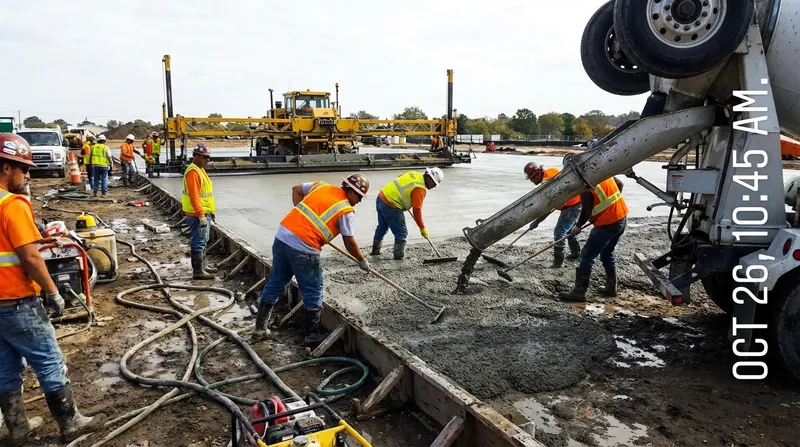
We split the work into sections and sequence them around your operation. Half the lot live while the other half cures. Docks taken two at a time rather than the whole row. Floors poured in bays with a temporary route maintained through the building. Night and weekend placements where the traffic pattern demands it.
The constraint that catches people out is cure time, not pour time. A section is not back in service the next morning — it is 10 days for cars and 28 for loaded trucks. Any phasing plan has to be built around those dates, and a contractor who promises otherwise is planning to hand you an early failure.
Accessible routes stay accessible throughout. If a phase takes out the only compliant path to an entrance, that phase gets a temporary route built into it, not an apology.
Commercial Concrete Across the Tennessee Valley
Huntsville is now the largest city in Alabama, around 233,600 people and still climbing. Redstone Arsenal, NASA Marshall and Cummings Research Park — the second-largest research park in the country — anchor a commercial base that keeps building, and Mazda Toyota Manufacturing has reshaped the industrial west side.
Twenty-five miles southwest, Decatur runs the busiest port on the Tennessee River with General Electric, 3M, Nucor, Daikin, Wayne Farms and United Launch Alliance in the mix. Between the two, we spend as much time on dock aprons and warehouse floors as on anything residential.
Local ground matters on commercial sites the same way it does on a driveway, only the consequences are larger. Shrink-swell clay under a 40,000 square foot floor, limestone voids under a dock apron, and more than 54 inches of rain a year on a lot that has to keep draining. We build the base for that and price it honestly.
We also handle the repair side — joint spalling, faulted panels, slab jacking under settled dock aprons. Details on the concrete repair page.
How a Commercial Project Runs
1. Site Walk
We walk it with whoever runs the site. Loading, traffic pattern, blackout hours, accessibility requirements and where the water currently goes.
2. Scope and Phasing Plan
Written scope with specs, phase map and reopening dates per phase. Nothing about cure time is left to conversation.
3. Demo and Subgrade
Sawcut clean edges, break out, haul off. Subgrade proof-rolled and soft spots dug out and rebuilt before any stone goes down.
4. Base and Steel
Crusher run compacted in lifts, rebar grid tied and chaired, dowel baskets set at construction joints where panels need to act together.
5. Place and Finish
Laser screed on large placements, power trowel finish on interior floors, broom or tined finish on exterior traffic surfaces. Cure compound the same day.
6. Joints and Turnover
Saw cut at 4 to 12 hours, joint fill once shrinkage has settled out, then turnover with the reopening dates confirmed in writing.
Related Commercial Work
Sidewalks and Curbing
ADA-compliant walks, curb ramps with detectable warnings, and curb and gutter for commercial sites.
Concrete Slabs
Equipment pads, mechanical yard slabs and outbuilding floors, sized to the actual load.
Foundations and Footings
Commercial footings, stem walls and structural pads poured to inspection and to the anchor template.
Commercial Concrete Questions From Facility Managers
Can you pour without closing our facility?
That is the normal request and the answer is phasing. We break the work into sections so a portion of the lot, dock or floor stays live, and we sequence around your delivery windows. It adds a day or two to the schedule and it is almost always cheaper than closing. The four things we need on the first call are the loading, the traffic pattern, the hours you cannot be down, and whether the area has to stay ADA-accessible throughout.
What thickness and strength do commercial drive lanes need?
Seven inches of 4,500 PSI with #4 rebar on a 12-inch grid over 6 inches of compacted crusher run, for anything loaded semis run on. Passenger-only parking bays can drop to 5 inches. The temptation is to spec the whole lot at the bay thickness to save money, and it works right up until a delivery truck cuts a corner across a bay. We map the truck path and thicken what it touches.
How do you handle joints in a warehouse floor?
Joints are the weakest part of an industrial floor and where forklift wheels do their damage, so we lay them out around traffic aisles and rack lines rather than dropping a uniform grid on the drawing. On heavy forklift traffic we use armored joints with steel edging, and dowel baskets across construction joints to keep the panels acting together and stop faulting. Saw cutting happens 4 to 12 hours after placement at a quarter slab depth.
Do you meet ADA requirements on ramps and walks?
Yes, and we build to the numbers rather than to the eye. Running slope on an accessible ramp stays at or below 1:12, cross slope at or below 1:48, with a 60-inch level landing at the top and bottom of every run and at any direction change. Detectable warning surfaces go in at curb ramps. Getting a cross slope wrong by half a degree is invisible on site and fails an inspection, so we shoot every surface rather than trusting a screed.
How soon can trucks use a new commercial slab?
Passenger vehicles at 10 days, loaded trucks and dumpsters at 28. Concrete reaches full design strength at 28 days and there is no admixture that changes that curve enough to matter for heavy loading. We will not shorten those dates to win a bid — a dock apron opened to semis at 14 days is an apron you re-pour early, and everybody involved knows it at the time.
What size commercial projects do you take?
Anything from a single dumpster enclosure pad up to full lot replacement and warehouse floors. We run four crews and 19 people out of Huntsville and we work the whole Tennessee Valley — Cummings Research Park and the Redstone corridor here, the industrial base down in Decatur, and everything between. Commercial work is priced per project after a site walk, not per square foot off a plan.
Send Us the Loading and the Hours You Can't Be Down
We will walk the site, build a phasing plan around your operation, and put the reopening dates in the scope.