
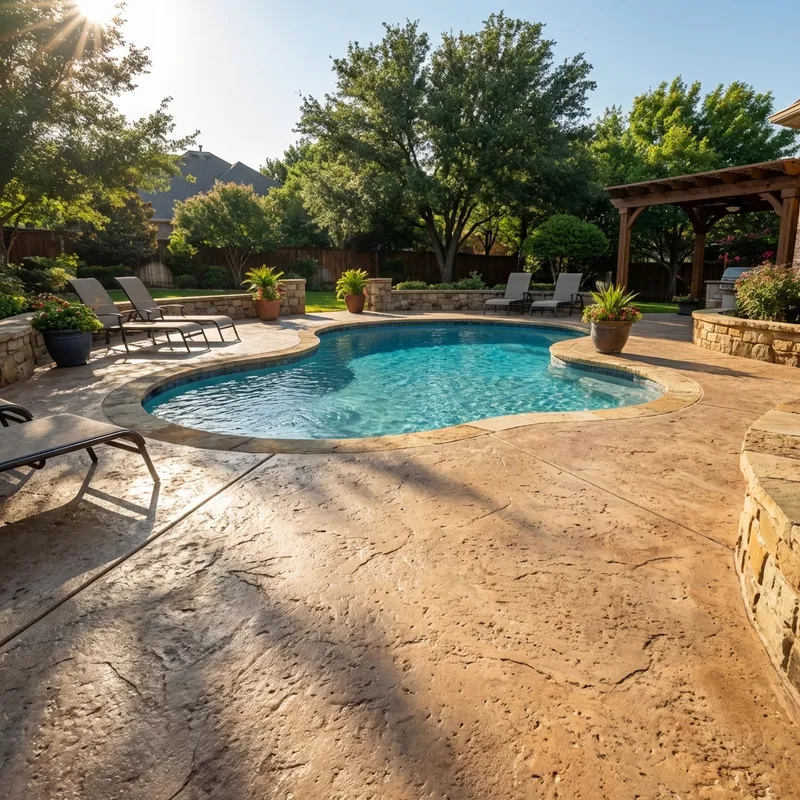
Concrete Pool Decks in Huntsville, AL
Huntsville Superior Concrete builds concrete pool decks in Huntsville, AL and has been finishing concrete in this valley since 1957. Slip-resistant textures, light colours that stay walkable in August, cool-deck overlays, and drainage designed around splash-out. $14 to $20 a square foot.
A pool deck is not a patio that happens to be near water. It has three constraints a patio does not: bare feet, constant moisture, and direct sun on a surface people stand on. Every decision we make comes back to one of those.
Pool Deck Surface Temperature and Colour Choice
This is the decision people get wrong most often, and it is irreversible without paying twice. A customer once picked a dark charcoal integral colour because it matched his house trim. We told him what would happen. He wanted it anyway, which is fair — it is his deck.
By the second week of July his kids could not cross it barefoot without hopping. We came back and put a light cool-deck overlay over the whole thing. He paid twice for one surface.
Now we bring a sample board to every pool deck estimate and ask people to hold the dark sample in direct sun for thirty seconds before choosing. Nobody has picked charcoal since. Light buffs, warm sands and pale grays all stay usable through a North Alabama August, and they read perfectly well against most house colours.
A cool-deck overlay adds another layer of defence — a light, textured topping that reflects more sun and holds less heat than bare concrete, while adding traction at the same time. $5 to $9 a square foot over a sound slab.
Pool Deck Finishes, Traction and Cost
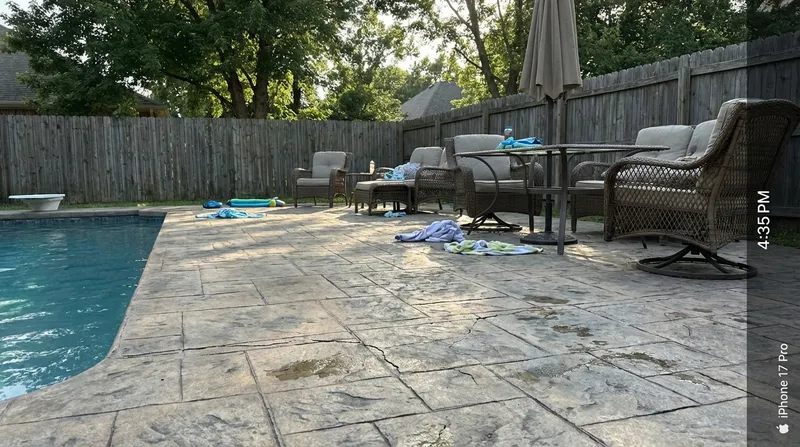
Every finish here works around a pool. The differences are wet traction, heat, and how much maintenance you are signing up for. There is no single right answer, but there is a wrong one for each household.
| Finish | Wet traction | Heat | Maintenance | Installed cost |
|---|---|---|---|---|
| Broom finish | Very good, unsealed | Low if light coloured | None required | $8 – $12 / sq ft |
| Knockdown texture | Very good | Low | Reseal 3–5 yrs | $10 – $14 / sq ft |
| Cool-deck overlay | Excellent | Lowest | Reseal 3–5 yrs | $14 – $20 / sq ft new; $5 – $9 over sound slab |
| Exposed aggregate | Excellent | Moderate | Reseal 3–5 yrs | $12 – $17 / sq ft |
| Stamped, sealed with grit | Good with grit additive | Depends entirely on colour | Reseal every 2–3 yrs | $16 – $24 / sq ft |
| Stamped, sealed without grit | Poor. We will not do it | — | — | — |
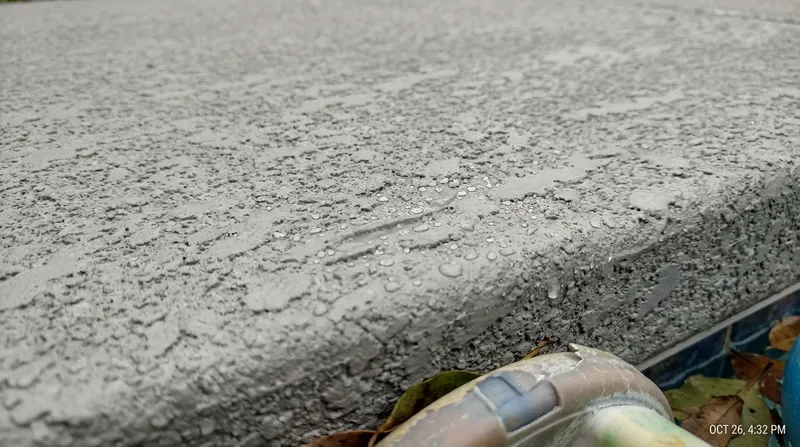
Polymer grit is broadcast into the sealer on every sealed pool deck we build. It is invisible once cured and it is not an optional upgrade on our jobs.
Pool Deck Drainage and the Joint at the Coping
A pool deck has to shed water in two directions at once: away from the house, and away from the pool. Splash-out, rain and hose water all need somewhere to go, and the default answer of sloping everything toward the pool means you are washing deck grit and sunscreen straight into the filter.
We slope the deck away from the pool at a minimum quarter inch per foot and pick up the water at the perimeter — a channel drain along the low edge where the grade cannot carry it away on its own. With more than 54 inches of rain a year here, that perimeter detail earns its keep quickly.
The other critical detail is the joint where the deck meets the pool coping. The pool shell and the deck slab are separate structures that move independently. A rigid connection between them cracks one or the other, and the one that cracks is rarely the one you would choose. That joint gets a compressible bond breaker and a flexible sealant, and it gets maintained — a failed coping joint lets water behind the pool shell.
Control joints across the deck get laid out to work with the pool's shape rather than cutting awkwardly across it. On decorative decks we hide them in the pattern's grout lines where we can.
Pool Deck Width and Layout
Width is where pool decks succeed or disappoint, and it is far cheaper to decide correctly than to add on later. These are working numbers, not minimums for their own sake.
| Zone | Minimum | Comfortable | What it allows |
|---|---|---|---|
| Walk-around perimeter | 4 ft | 6 ft | Passing someone without stepping off |
| Lounger side | 8 ft | 10 ft | Chairs plus a clear walking path behind them |
| Dining or gathering side | 10 ft | 12 ft | Table, chairs pushed back, and circulation |
| Diving board / slide clearance | Per manufacturer | — | Non-negotiable safety dimension |
| Equipment pad access | 3 ft | 4 ft | Room to service the pump without contortion |
If the budget will not stretch to the width you want on every side, put it on one side rather than spreading it evenly. A wide gathering side and a narrow walk-around beats a uniform 6 feet with nowhere to sit.
Pool Deck Installation Process
1. Layout, Width and the Sample Board
We mark the deck edge on the ground so you can walk it and place a lounger. Then the colour samples come out and go in the sun. Ten minutes here prevents the two most common pool deck regrets.
2. Excavation, Grade and Drains
Excavated to depth with the fall set away from both the pool and the house. Channel drain runs and outfalls go in now, because adding drainage to a finished deck means cutting it.
3. Base and Reinforcement
Four inches of compacted #57 stone, then 6x6 mesh or rebar depending on the deck. Four inches of 4,000 PSI air-entrained concrete — the air entrainment matters more here than almost anywhere, especially on a saltwater pool.
4. Coping Joint and Forms
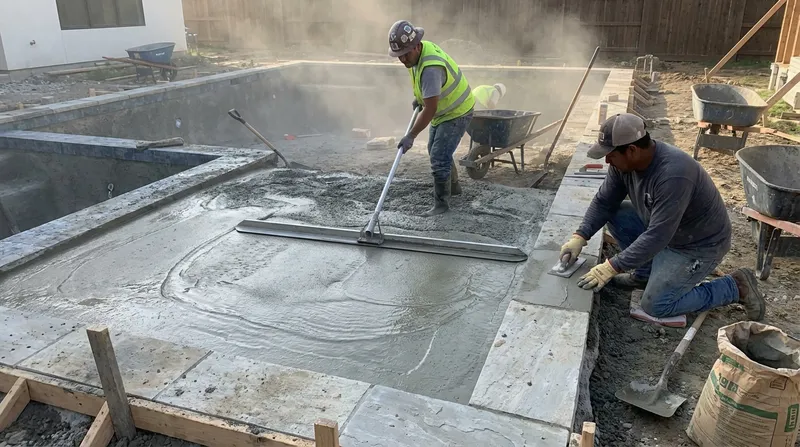
Compressible bond breaker set against the coping so the deck and the pool shell can move independently. Forms follow the pool's curves rather than approximating them with straight segments.
5. Place, Texture and Cure
Placed to the drainage plan, then the chosen texture applied once the bleed water has gone. Cure-and-seal the same day. Overlays and cool-deck toppings go on after the base slab has cured.
6. Seal With Grit at 28 Days
First sealer coat at 28 days with polymer grit broadcast in. Sealing earlier traps moisture and clouds the finish. Then reseal every 3 to 5 years, or 2 to 3 on stamped work.
Work That Usually Comes With a Pool Deck
Patios and Walkways
The path from the back door to the pool, and the covered dining area next to it. Poured together, they share mobilization.
Stamped & Decorative Concrete
Pattern and colour options for the deck — with grit in the sealer and light colours in the mix.
Retaining Walls
Pools on sloped lots need the grade held. A wall retaining ground behind a pool is a surcharge case and gets engineered.
Concrete Pool Deck Questions
How do you stop a pool deck from getting too hot to walk on?
Two things, and colour is the bigger one. Light colours reflect; dark colours absorb, and a dark integral colour under July sun in North Alabama produces a surface nobody crosses barefoot between noon and five. That is physics, not preference. A cool-deck overlay is the second lever — a light-coloured textured topping that reflects more and holds less heat than a bare slab. We bring a sample board to every pool deck estimate and make people hold the dark sample in direct sun for thirty seconds before they choose. It changes a lot of minds.
Is concrete slippery around a pool?
Sealed concrete can be, and that is a real objection with a real answer. A broom or knockdown texture gives good wet traction on its own. If the deck is being sealed — which any decorative finish requires — we broadcast a polymer grit into the sealer coat. It is invisible once cured and it transforms wet traction. On pool surrounds we do that as standard rather than as an option, because a sealed slate pattern with no grit next to water is a genuinely bad idea.
How wide should a pool deck be?
Four feet is the minimum for walking access all the way around and it feels like a ledge. Six feet works for circulation. Eight to twelve feet on at least one side is what you need for loungers, a table, or anywhere people will actually gather. Most pool deck regret we hear about is width — the deck is technically complete and there is nowhere to put a chair without blocking the path.
Do saltwater pools damage concrete decks?
They are harder on concrete than a chlorine pool, yes. Salt-laden splash-out and evaporation cycles drive salt crystals into the surface pores, and those crystals expand as they grow. Over years that causes surface scaling. The defences are air-entrained concrete at 6% ± 1.5%, a good penetrating siloxane sealer maintained on schedule, and drainage that moves splash-out off the deck rather than letting it evaporate in place. Tell us it is a saltwater pool at the estimate — it changes the sealer specification.
Can you resurface my existing pool deck instead of tearing it out?
If the slab is structurally sound and its cracks are dormant, yes. A cool-deck or decorative overlay runs $5 to $9 a square foot and is a genuinely good value against $14 to $20 for a new deck. What kills the idea is active movement — an overlay bonded to a slab that is still working will telegraph every crack back through within two seasons. We check the cracks for movement and check the slab's drainage before we quote an overlay.
How long after pouring can we use the pool deck?
Foot traffic at 24 to 48 hours, furniture at 7 days, and full design strength at 28 days. If the deck is getting a decorative sealer, that first coat goes on at 28 days rather than sooner, because sealing a slab that has not finished releasing moisture traps it and causes the sealer to cloud. The pool itself is usually usable well before the deck is fully finished — we sequence around that.
Hold the Colour Sample in the Sun Before You Decide
We bring the sample board and mark the deck width on the ground at the estimate. Thirty seconds with the dark sample has saved several people from paying twice.