
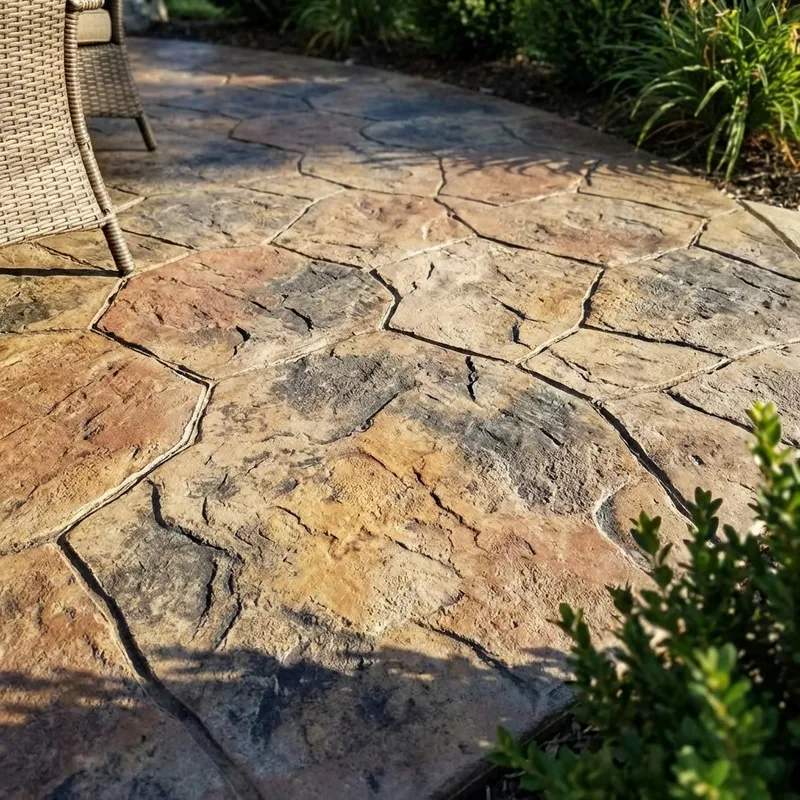
Stamped and Decorative Concrete in Huntsville, AL
Huntsville Superior Concrete installs stamped and decorative concrete in Huntsville, AL, and has been finishing concrete in this valley since 1957. Ashlar slate, random stone, wood plank, brick and seamless texture, with integral color mixed through the full slab rather than dusted on top.
$16 to $24 a square foot installed, sealer included. Before you commit, know the trade: stamped concrete needs resealing every two to three years. We would rather tell you that now than sell you a patio you resent in year five.
Stamped Concrete Patterns We Run
Pattern choice is mostly about scale. Large-format patterns look deliberate on a big patio and cramped on a small one. Small repeating patterns do the opposite. We bring the mats to the estimate so you can see them at size instead of picking from a two-inch photo.
Ashlar Slate
Rectangular stone in mixed sizes with a slate texture. The most requested pattern we run and the most forgiving — the irregular joint lines hide minor surface variation, and it reads correctly at almost any patio size. Works with two-tone color better than anything else in the catalog.
Random Broken Stone
Irregular flagstone shapes with no repeating grid. The most natural looking option and the most labor to lay out, because the mats have to be rotated and hand-detailed so the eye never catches a repeat. Best on larger patios where a formal grid would look forced.
Wood Plank
Board-by-board texture with real grain and knot detail, laid in random lengths. Popular for covered porches and pool surrounds where people want the look of a deck without the annual staining, the rot or the wasps under it. Takes hand-detailing at the ends of each run to look right.
Brick and European Fan
Herringbone, running bond and basketweave brick, plus fan-pattern cobble. These sit well against the older brick housing stock around Huntsville and in Decatur's Victorian districts, where a modern slate pattern can look imported from a different decade.
Seamless Texture Skin
No joint lines at all — a flexible skin that leaves a natural stone texture across the whole surface. Combined with saw-cut lines in a custom layout, it lets you set your own scale rather than accepting whatever grid the mat maker chose. Our default for contemporary homes.
Borders and Banding
A stamped or contrasting-color band around a broom or texture field. You get the decorative payoff at the edges where people actually look, and you keep the maintenance burden to a narrow strip. On driveways this is usually the smartest money in the whole catalog.
Decorative Concrete Color Systems Compared
There are four ways to get color into concrete and they behave completely differently over ten years. Most complaints about faded stamped concrete trace back to somebody buying a surface-applied system and expecting integral-color durability.
| System | How it works | Fade behaviour | Cost impact |
|---|---|---|---|
| Integral color | Pigment batched into the truck, colors the full slab depth | Very stable. A chip reveals the same color underneath | +$1.50 – $3.00 / sq ft |
| Dry-shake color hardener | Broadcast onto the fresh surface and floated in, 1/8" deep | Rich and dense, but wears at high-traffic spots over time | +$2.00 – $3.50 / sq ft |
| Acid stain | Reacts chemically with lime in the cured slab, mottled finish | Permanent chemically, but needs sealer to stay vivid | +$3.00 – $6.00 / sq ft |
| Water-based stain | Sits in the surface pores, widest color range | Most sealer-dependent of the four | +$2.50 – $5.00 / sq ft |
Our standard recommendation for anything in full sun: integral color as the base, then a secondary release or antiquing color for depth. That way the sun is fighting pigment that runs all the way through.
Release Agents and Why Your Patio Has Two Colors
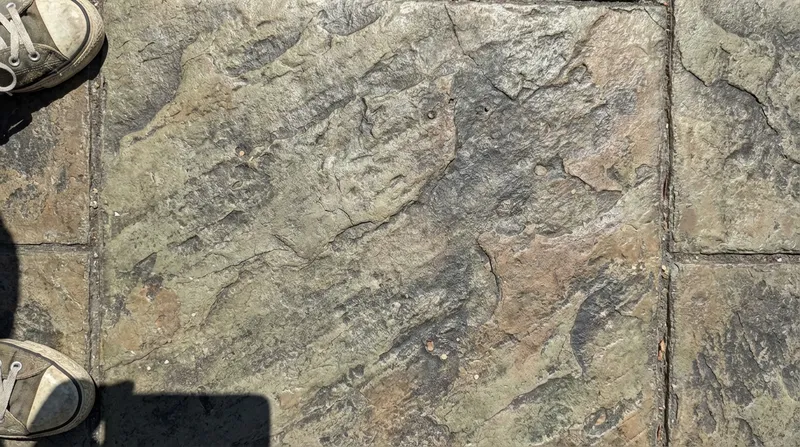
Release agent stops the stamp mat sticking to fresh concrete. Powder release is also a pigment, so it leaves a secondary tone in the texture's low spots — that antiqued, two-tone depth that makes stamped concrete look like stone instead of like colored concrete with a pattern pressed in.
Liquid release leaves no secondary color, which is what you want when the design calls for a single flat tone. Powder release has to be washed off before sealing, and rushing that wash is a common reason a patio looks blotchy at handover. We wash, let it dry fully, then seal.
Stamped Concrete Installation Process
1. Sample Board and Layout
We bring physical samples in your chosen colors and lay the mats out on site so you see the pattern at real scale. On pool decks we make people hold the dark sample in direct sun for thirty seconds first. That single step has changed a lot of minds.
2. Base, Forms and Steel
Decorative work sits on the same structure as plain flatwork — 4 inches of compacted #57 stone or crusher run, 4-inch slab with 6x6 mesh on patios, 5 inches with #4 rebar on driveways. A beautiful surface over a bad base is a short-lived patio.
3. Colored Pour and Float
Integral pigment is batched at the plant, so the color arrives in the truck rather than getting mixed on site. Place, screed, bull float, then wait. Stamping into concrete that is still bleeding destroys the surface.
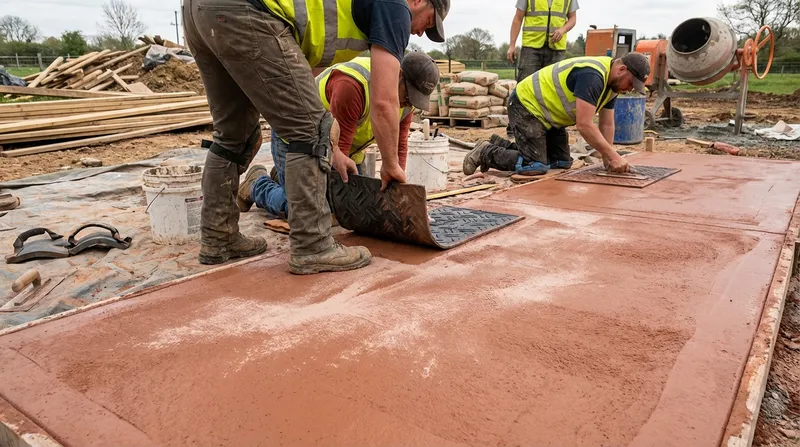
4. Release and Stamping
Release goes down, then the mats, in sequence, tamped for full impression depth. This is the part with no second chance — the window between too wet and too stiff is short, which is why stamping is a crew job and not a two-person job.
5. Hand Detailing and Joints
Mat edges, borders and any spot the mats could not reach get hand tooled. Control joints are cut into the pattern's grout lines where possible so the functional joint disappears into the design rather than cutting across it.
6. Wash, Cure and Seal
Powder release gets washed off and the slab dries fully. First sealer coat goes on at 28 days, with a polymer grit broadcast into it on anything near water or on a slope. Then reseal every two to three years for the life of the patio.
When We Talk People Out of Stamped Concrete
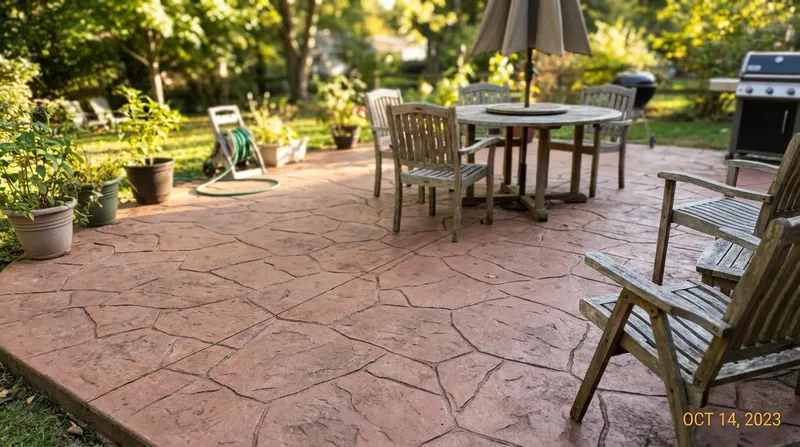
If nobody in the house is going to reseal it every two to three years, do not buy it. That is not a scare tactic, it is the maintenance schedule. Exposed aggregate at $12 to $17 a square foot looks good unsealed and ages gracefully with no attention at all.
If the lot holds water, fix the drainage first. We have talked more than one homeowner out toward the Flint River off a stamped driveway and into a crowned broom finish with a French drain. A stamped pattern under two inches of standing water is an expensive puddle, and they got about $4,000 back to spend on something that mattered.
And skip the darkest colors on any surface people cross barefoot. Dark integral color plus North Alabama sun in July produces a patio nobody uses between noon and five. That is physics, not preference. We have fixed one of those with a light overlay after the fact, and the homeowner paid twice for one surface.
Where Decorative Concrete Usually Goes
Patios and Walkways
The most common home for stamped work. Plain broom is $8–$12 a square foot if you want the space first and the decoration later.
Pool Decks
Stamped patterns around water need grit in the sealer and light colors in the mix. We do both as standard, not as an upsell.
Driveways
A stamped border on a broom field gets you most of the visual payoff for a fraction of the maintenance.
Stamped and Decorative Concrete Questions
How much does stamped concrete cost in Huntsville?
$16 to $24 per square foot installed, which covers the slab, integral color, the stamp pattern, the release and the first coat of sealer. A 16 by 20 patio is 320 square feet, so $5,100 to $7,700. A plain broom-finish patio of the same size is $2,600 to $3,800, so you are paying roughly double for the decorative work. Where you land in the range depends mostly on how many colors are involved and whether the pattern needs hand-detailing at the borders.
How often does stamped concrete need to be resealed?
Every two to three years, and this is the part people underestimate. Sealer is what keeps the color saturated and the pattern crisp. Let it go five or six years and the surface goes chalky, the color fades unevenly where the sun hits hardest, and the release powder trapped in the low spots starts washing out. Resealing a 320 square foot patio runs a few hundred dollars. Recovering a neglected one costs considerably more. If nobody in the house will keep up with it, we would honestly rather sell you exposed aggregate.
Is stamped concrete slippery when wet?
Sealed stamped concrete can be, yes — that is a real objection and the answer is an additive, not a shrug. We broadcast a polymer grit into the sealer coat on anything near water or on any sloped walking surface. It is invisible once cured and it changes the wet traction completely. On pool surrounds we do this as standard rather than as an option, because a sealed slate pattern with no grit around a pool is a genuinely bad idea.
Will the color fade in Alabama sun?
Integral color barely fades, because the pigment is mixed through the full depth of the concrete rather than sitting on top. Surface-applied color — dry-shake hardener, acid stain, water-based stain — is more exposed and depends heavily on sealer maintenance. That is the main reason we push integral color as the base layer on anything in full sun, then use surface color for accent and antiquing rather than as the whole system.
Can you stamp over my existing concrete patio?
Sometimes. A stamped overlay needs a structurally sound base slab with no active movement across cracks. If the existing slab is sound, an overlay runs $5 to $9 a square foot and is a genuinely good value. If the slab is cracked and still moving, the overlay will telegraph every one of those cracks back through within two seasons. We check the slab before we quote the overlay, and if it fails that check we will say so.
What patterns and colors do you actually offer?
Ashlar slate, random broken stone, wood plank, herringbone and running bond brick, European fan cobble, and seamless texture skins for a natural stone look with no repeating grid. Colors run from the warm tans and buffs that suit brick homes through the grays that work against modern siding. The integral pigments we spec come from the two big US makers, Davis Colors and Solomon Colors, so what you see on the sample board is what cures out on your patio.
See the Patterns at Full Size Before You Decide
We bring the mats and the color samples to the estimate and lay them out on your actual patio footprint. No obligation, no deposit to look.