
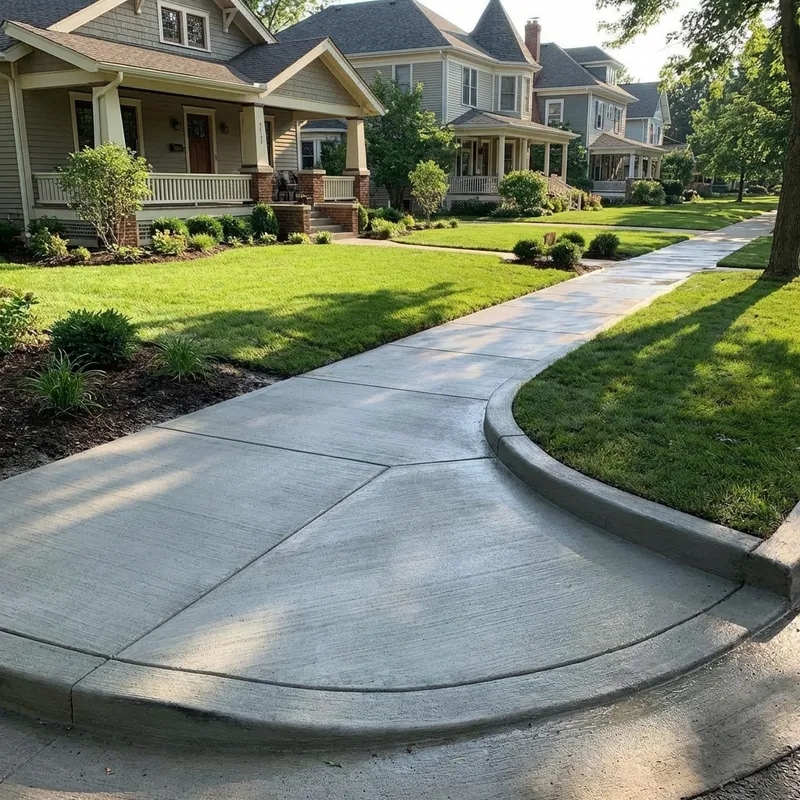
Concrete Sidewalks and Curbing in Huntsville, AL
Huntsville Superior Concrete pours concrete sidewalks and curbing in Huntsville, AL, and has been doing it here since 1957. ADA-compliant accessible routes and curb ramps, curb and gutter, residential walks and steps, decorative landscape curbing, and trip hazard remediation.
Sidewalk work lives or dies on slopes measured to a hundredth, not eyeballed. We shoot every surface with a level rather than trusting a screed, because a cross slope that is half a degree out is invisible on site and still fails an inspection.
ADA Sidewalk and Curb Ramp Requirements
These are the numbers that decide whether a walk passes. None of them are visible to the eye at the tolerances involved, which is why we shoot every surface rather than trusting a screed and a good feeling.
| Requirement | Limit | Why it matters |
|---|---|---|
| Clear width | 36 in minimum | Below this it is not an accessible route at all |
| Passing space | 60 x 60 in | Required where a 36-inch walk runs a distance without one |
| Running slope (walk) | 1:20 max | Steeper than this and it is legally a ramp with ramp requirements |
| Running slope (ramp) | 1:12 max | The hard ceiling on any curb or access ramp |
| Cross slope | 1:48 max | The single most commonly failed dimension. Invisible to the eye |
| Landings | 60 in level, top and bottom | Also at every direction change on a ramp run |
| Vertical surface change | 1/4 in untreated; 1/4–1/2 in beveled at 1:2 | Above 1/2 in it has to be ramped. This is the trip hazard threshold |
| Detectable warning | Required at curb ramps | Truncated dome surface at the street transition |
That quarter-inch trip hazard threshold is lower than most property owners assume, and it is the number that comes up when somebody falls. Worth measuring your own walk against.
Trip Hazard Repair Without Replacing the Whole Walk
A raised panel edge is the most common sidewalk problem we get called about, and full replacement is rarely the right first answer. There are three fixes and they scale with severity.
Grinding shaves the high side down to a compliant transition. It works up to roughly three-quarters of an inch of offset, it is the cheapest option, and it is done the same day. Beyond that the grind starts eating too much of the panel's thickness to be sensible.
Polyurethane slab jacking lifts the low side back to plane instead — $650 to $2,400, no demolition, back in service the same day. This is the right call when a panel has settled and the concrete itself is still sound, which describes most of the settled walks in older Huntsville neighborhoods.
Replacement is for panels that have actually failed — cracked into pieces, surface scaled through, or lifted by roots that are still there. On a commercial property, note that the quarter-inch threshold is a liability number as much as a compliance one, and it is worth walking your own frontage with a ruler once a year.
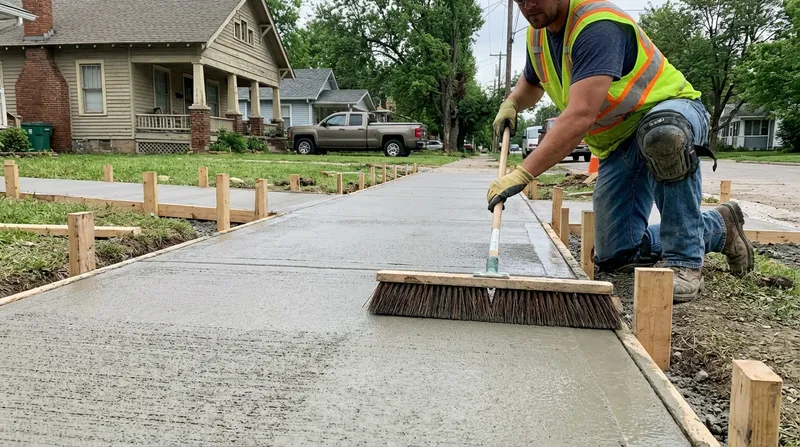
Sidewalk and Curbing Work We Do
Public Sidewalks and Accessible Routes
Four inches of 4,000 PSI with 6x6 mesh over 4 inches of compacted stone, thickened to 6 inches with rebar wherever a vehicle crosses. Built to the municipal detail for your jurisdiction and shot for slope at every panel.
Curb Ramps and Detectable Warnings
1:12 running slope, 1:48 cross slope, 60-inch level landings, flared sides where pedestrians cross them, and a truncated dome detectable warning surface at the street. These are inspected against the numbers, so we build against the numbers.
Curb and Gutter
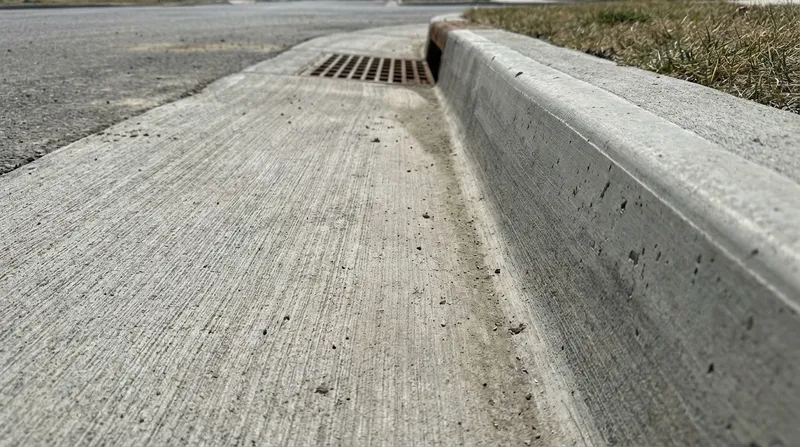
Structural stormwater infrastructure — poured curb with an integral gutter pan, built to the municipal cross-section and set to carry water to the existing inlets. Getting the flow line right matters more than getting the face straight, though we do both.
Residential Walks and Steps
Front entry walks at 48 inches wide where the house scale supports it, service walks at 36. Riser heights held within a quarter inch across a flight, because the human foot calibrates on the first step and trips on the one that differs.
Decorative Landscape Curbing
Extruded borders around beds and tree rings, typically 6 inches wide and 4 to 6 inches tall, with optional colour and a stamped edge pattern. Keeps mulch in and gives a mower a clean line to run against. Different job and different money from curb and gutter.
Historic District Walks
In Twickenham and Old Town here, the antebellum blocks of Athens, and Decatur's Albany and Old Decatur districts, we cut joints to the original walk's proportions rather than the standard 10-foot rule, and steer toward exposed aggregate with a warmer sand at $12 to $17 a square foot. Current spec underneath, correct appearance on top.
Right-of-Way Permits Across the Tennessee Valley
Sidewalks are the one category where the jurisdiction question comes up every single time, because so much of this work sits in a public right-of-way rather than on private property.
The City of Huntsville reviews its own right-of-way work. So does Madison — and a good number of Madison addresses are actually in Limestone County rather than Madison County, which surprises people. Brownsboro is unincorporated, so it goes through Madison County, whose building resolutions were updated effective January 2021. Athens is the Limestone County seat with a city line that plenty of Athens-addressed property falls outside of. Decatur straddles Morgan and Limestone counties.
We work out which office your specific parcel answers to before the estimate goes out. An out-of-town crew that guesses wrong finds out on inspection day, and the property owner is the one holding the problem.
On commercial sites we also keep an accessible route open through every phase of the work. If a phase takes out the only compliant path to an entrance, a temporary route is built into that phase. See the commercial concrete page for how we phase live sites.
Sidewalk Installation Process
1. Survey and Jurisdiction
Existing slopes shot, right-of-way line confirmed, and the correct permitting office identified for your parcel before anything is quoted.
2. Saw Cut and Removal
Clean saw cuts at panel joints so the transition to the existing walk is a joint rather than a ragged break. Broken concrete hauled off, not buried.
3. Subgrade, Roots and Base
Root conflicts resolved with an arborist rather than a chainsaw, root barrier installed where needed, then 4 inches of stone compacted in lifts.
4. Forms Set to Slope
Every form shot with a level for both running and cross slope, not set by eye. Mesh or rebar placed and chaired to mid-slab.
5. Place, Finish, Joint
4,000 PSI placed and broomed for traction, joints tooled or cut at panel spacing, detectable warning surfaces set into curb ramps while the concrete is workable.
6. Verify and Open
Finished slopes re-shot and recorded before we leave. Foot traffic at 24 to 48 hours; vehicle crossings at 10 days.
Why Sidewalks Fail Where They Do
Almost every broken sidewalk in this valley failed in one of four places, and all four are avoidable at the pour.
Where cars cross it, because somebody poured 4 inches with mesh across a driveway apron instead of 6 inches with rebar. Over tree roots, because the roots were never dealt with. At a utility trench, because the backfill was never compacted in lifts. And at the panel joints, because the joints were tooled shallow and cracked beside themselves rather than at the line.
None of those are concrete quality problems. They are detailing problems, and detailing is what you are buying when you hire a crew that has been pouring in Madison County since 1957.
If your walk is settled rather than broken, lifting it is usually cheaper and faster than replacing it. That is covered on the concrete repair page.
Related Concrete Work
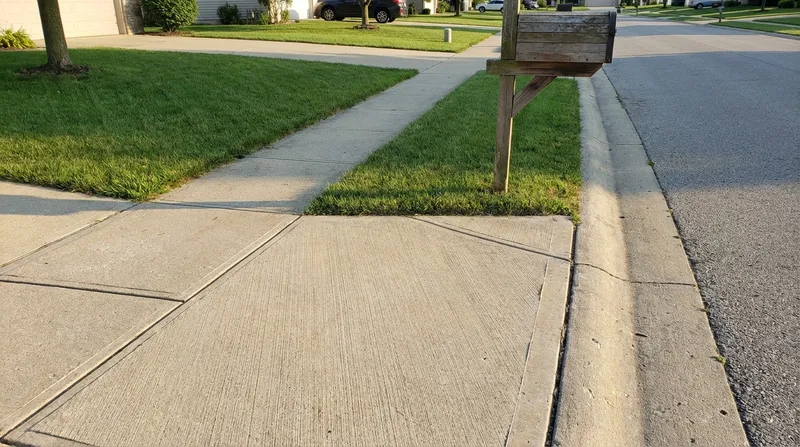
Trip Hazard and Panel Repair
Grinding, polyurethane slab jacking from $650, and single-panel replacement when a walk has settled rather than failed.
Commercial Concrete
Parking lots, ADA routes, curb and gutter and dock aprons, phased so your site keeps operating.
Patios and Walkways
Residential walks, entry steps and the patio they lead to, priced together to share mobilization.
Sidewalk and Curbing Questions
What are the ADA rules for a sidewalk?
The ones that catch people out are the slopes. Running slope on an accessible route stays at or below 1:20 before it counts as a ramp, cross slope at or below 1:48, and clear width at 36 inches minimum with 60-inch passing spaces where the walk is narrower over a distance. Vertical changes in surface over a quarter inch have to be beveled, and anything over half an inch has to be ramped. A curb ramp caps out at 1:12 running slope with a 60-inch level landing top and bottom, plus a detectable warning surface at the street.
My sidewalk has a raised edge someone could trip on. What are my options?
Three, in ascending cost. Grinding shaves the high side down and works for offsets up to roughly three-quarters of an inch. Polyurethane slab jacking lifts the low side back to plane, $650 to $2,400, and is the right call when the panel has settled but the concrete is sound. Replacement of the panel is the answer when the concrete itself has failed. For reference, ADA treats anything over a quarter inch as needing treatment — which is a lower bar than most property owners assume, and it matters for liability.
Do I need a permit to replace a sidewalk in Huntsville?
If the walk is in the public right-of-way, yes, and the jurisdiction depends on your address. The City of Huntsville reviews its own right-of-way work, Madison handles its own, unincorporated areas like Brownsboro go through Madison County, and plenty of Madison-addressed property actually sits in Limestone County. We confirm which office your parcel answers to as part of the estimate rather than after we have broken concrete.
Tree roots have lifted my sidewalk. Can you fix it permanently?
Only if the roots are dealt with, and that is an arborist decision before it is a concrete one. Cutting structural roots can destabilise a mature tree. What usually works is a root barrier plus a re-poured panel, sometimes with the walk routed slightly around the trunk. What never works is re-pouring over the same roots and hoping — you will be back inside five years. We will tell you that at the estimate instead of taking the easy job twice.
What's the difference between curb and gutter and landscape curbing?
Curb and gutter is structural drainage infrastructure — a poured curb with an integral gutter pan that channels stormwater to inlets, built to a municipal detail. Landscape curbing is a small extruded decorative border around beds, typically 6 inches wide and 4 to 6 inches tall, that holds mulch in and keeps a mower line clean. Completely different jobs, completely different money. We do both, but people sometimes ask for one and mean the other.
How thick should a sidewalk be?
Four inches of 4,000 PSI over 4 inches of compacted stone for pedestrian walks, with 6x6 mesh. Where a vehicle will cross it — a driveway apron interrupting a public walk, or a service route — it goes to 6 inches with #4 rebar. That transition is one of the most commonly ignored details in this trade, and it is why so many sidewalks are broken in exactly the spot where cars cross them.
Get Slopes Measured, Not Estimated
We shoot every surface and record the finished slopes before we leave. We also work out which permitting office your parcel answers to.