
Concrete Slabs in Huntsville, AL
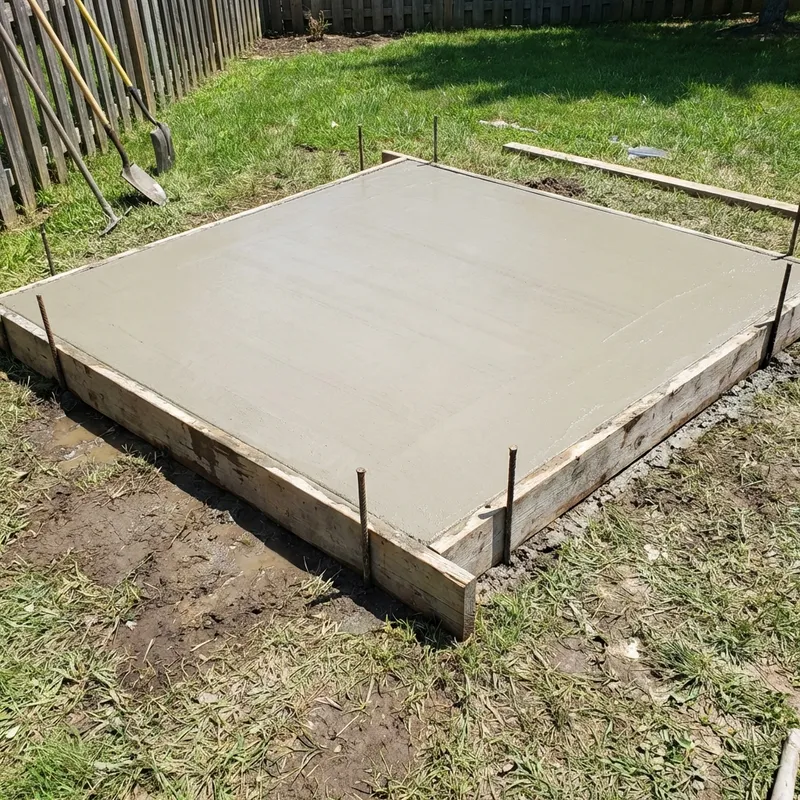
Huntsville Superior Concrete pours concrete slabs in Huntsville, AL and has been doing it in this valley since 1957. Garage floors, shop and workshop slabs, shed and barn pads, RV pads, hot tub pads, HVAC and generator bases.
Standard spec is 5 inches of 4,000 PSI with #4 rebar on 18-inch centers, 4 inches of compacted crusher run underneath, and a 10-mil vapor barrier on anything enclosed. $8 to $11 a square foot. Six inches at 4,500 PSI where equipment is going on it.
Concrete Slab Thickness by Application
Slab thickness is a load question, not a preference. Work out what the heaviest thing on it will be, including the day the moving truck backs up to it, and spec from there. Under-building a slab is the one mistake you cannot fix later without demolition.
| Slab | Thickness | Strength | Reinforcement | Approx. cost |
|---|---|---|---|---|
| Shed / storage building pad | 4 in | 4,000 PSI | 6x6 mesh | $8 – $10 / sq ft |
| Garage floor | 5 in | 4,000 PSI | #4 @ 18 in | $8 – $11 / sq ft |
| Workshop / hobby shop | 5 in | 4,000 PSI | #4 @ 18 in | $8 – $11 / sq ft |
| Shop with a vehicle lift | 6 in + thickened at columns | 4,500 PSI | #4 @ 12 in | $11 – $14 / sq ft |
| Barn / equipment pad | 6 in | 4,500 PSI | #4 @ 12 in | $11 – $14 / sq ft |
| RV pad | 6 in | 4,000 PSI | #4 @ 12 in | $11 – $14 / sq ft |
| Hot tub pad | 6 in | 4,000 PSI | #4 @ 12 in | $1,200 – $2,200 |
| HVAC / generator pad | Per point load | 4,000–4,500 PSI | Designed to load | Call — we quote these |
10-mil vapor barrier on every enclosed slab. 6% ± 1.5% air entrainment on anything exposed to weather. No minimum job size — a single equipment pad is a job we will take. The per-square-foot rate is higher on small work because mobilization and the minimum concrete order do not scale down.
Vapor Barriers and Why an Enclosed Slab Needs One
Concrete is porous. Ground moisture moves up through a slab continuously by capillary action, and in North Alabama there is always ground moisture — more than 54 inches of rain a year over clay that holds water like a sponge.
In an open carport nobody notices. In an enclosed garage or shop, that moisture has to go somewhere, and it goes into the air, into whatever is sitting on the floor, and underneath any coating you apply. Peeling epoxy is almost always a moisture problem rather than a product problem.
The answer is a 10-mil polyethylene sheet under the slab, taped at every lap and turned up at the perimeter. It costs very little relative to the pour, and there is no way to add it afterwards. Skipping it is one of the most common corners cut on cheap slab bids, and it is invisible the day you take delivery.
If you might ever coat the floor, tell us at the estimate. Coatings need a bondable surface profile and a passed moisture test, and both of those are decisions we make on pour day rather than repairs we make later.
Slabs We Pour and What Each One Needs
Garage and Shop Floors
Five inches, rebar on 18-inch centers, vapor barrier, and a fall toward the door of about an eighth of an inch per foot so a wet car drains out instead of pooling at the back wall. Light steel trowel finish if a coating is coming, broom if it is not.
Metal Building Slabs
The dimensions have to match the building exactly, so we work from the manufacturer's anchor template and footprint tolerances rather than a sketch. Anchor bolts are wet-set and verified against the template before the concrete stiffens. Thickened edges where the building's columns land.
Barn and Equipment Pads
Six inches of 4,500 PSI over 6 inches of compacted crusher run, with rebar on a 12-inch grid. Topsoil stripped entirely — the fertile ground out around Athens and Limestone County is excellent for crops and the worst possible thing to leave under a slab. Sloped a quarter inch per foot away from the building.
RV and Boat Pads
Six inches with rebar on 12-inch centers. A motorhome concentrates most of its weight on a small number of contact points and it sits in the same spot for months at a time, which is a very different load case from a car that moves daily. Size the pad for the tow vehicle too.
Hot Tub Pads
Run the numbers before you pick a size. A filled and occupied six-person tub often lands between 4,000 and 6,000 pounds on a small footprint. Six inches, #4 rebar at 12 inches, and at least 6 inches of slab past the tub shell on every side. Level matters here more than anywhere — an unlevel tub stresses its own shell.
HVAC, Generator and Utility Pads
Sized to the equipment's actual point load and anchor pattern rather than to a standard detail. Standby generators in particular have specific pad requirements from the manufacturer, and getting the conduit stub-ups cast in correctly saves the electrician a bad day.
Concrete Slab Installation Process
1. Load Review and Layout
We ask what is going on the slab, including the heaviest thing that will ever touch it. Then dimensions get set from the building template if there is one, because a metal building will not forgive a slab that is an inch out.
2. Strip and Excavate
Topsoil comes off completely. It compresses and holds water and it is the single worst material to leave under a slab. Soft spots get dug out and rebuilt rather than bridged.
3. Base in Compacted Lifts
Four inches of crusher run for standard slabs, 6 for heavy-duty, placed in lifts with a plate compactor over each. One thick lift dumped and rolled once is not compaction, it is optimism.
4. Vapor Barrier and Steel
10-mil down, taped at laps, turned up at the perimeter, and not walked through. Rebar tied and chaired to sit mid-slab. Rebar lying on the plastic does almost nothing.
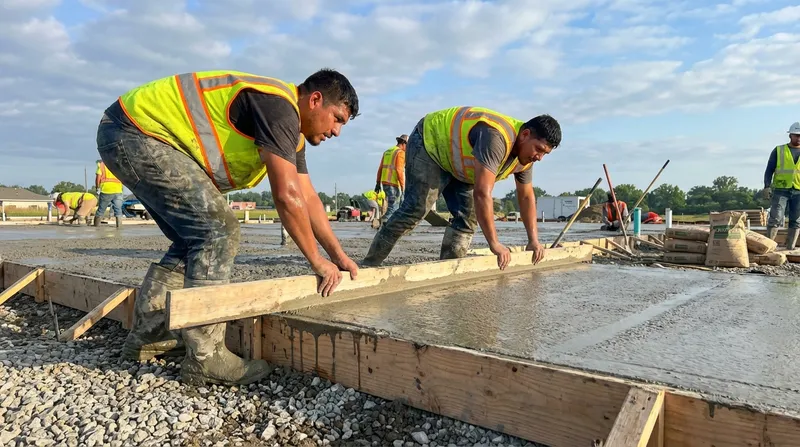
5. Place, Screed and Finish
4,000 or 4,500 PSI at a 4 to 5 inch slump, no water at the chute. Screeded, bull floated, then power troweled or broomed depending on what is going on the floor. Anchor bolts wet-set and checked.
6. Joints, Cure and Handover
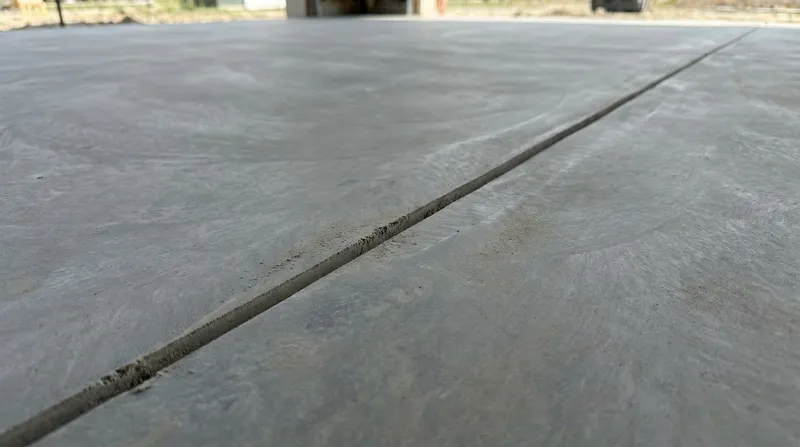
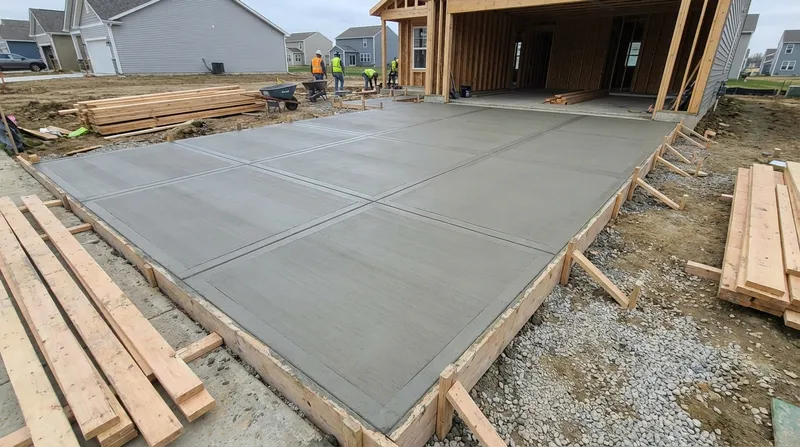
Control joints cut 4 to 12 hours after finishing at a quarter of the slab depth, 12 feet apart on a 5-inch slab. Cure method chosen around whether a coating is coming. Full strength at 28 days.
What the Ground Under a North Alabama Slab Does
Shrink-swell clay is the constant. It takes on water through a wet spring, expands, then contracts through a dry August. A slab sitting directly on it rides that movement. A slab sitting on four well-compacted inches of crusher run mostly does not, because the stone layer distributes the movement instead of transmitting it.
On newer subdivision lots around Madison and west Huntsville, the other factor is fill. Ground graded two or three years ago is still consolidating. That is exactly the situation the rebar grid earns its keep in — it will not stop a crack forming over a soft spot, but it keeps both sides of that crack in the same plane, which is what actually ruins a floor.
Out toward Brownsboro and the Flint River, drainage comes first. A slab on bottomland gets its water routed before its finish gets chosen, and the vapor barrier is doing real work there rather than being a checkbox.
And under all of it, limestone. If a site shows one localized soft spot that does not match the rest of the ground, we would rather have it looked at than pour over it. See the foundation page for how we handle bearing and karst.
Related Slab and Structural Work
Foundations and Footings
Footings, stem walls and monolithic slabs for new buildings and additions, dug to bearing.
Driveways
The apron that connects a new garage slab to the street. Poured together, the two jobs share mobilization.
Slab Repair and Lifting
Polyurethane slab jacking from $650 when an existing slab has settled but the concrete is still sound.
Concrete Slab Questions
How thick does a garage or shop slab need to be?
Five inches of 4,000 PSI with #4 rebar on 18-inch centers over 4 inches of compacted crusher run, plus a 10-mil vapor barrier. That is our standard and it handles vehicles, tool storage and normal shop use. If a two-post lift, a tractor or a loaded trailer is going on it, we move to 6 inches at 4,500 PSI with rebar on a 12-inch grid, and we thicken the footing locally under lift columns to spread the point load.
Do I really need a vapor barrier under a slab?
Under anything enclosed, yes, without exception. A 10-mil sheet taped at the laps and turned up at the edges. Skip it and the slab wicks ground moisture continuously for the rest of its life. You find out about it when a floor coating peels, when tools left on the floor rust from the bottom up, or when the shop smells damp every spring. Retrofitting a vapor barrier is not a thing — you either put it in or you live without it.
What size and thickness does a hot tub pad need?
Do the weight math first. A six-person hot tub filled and occupied commonly runs 4,000 to 6,000 pounds, concentrated on a small footprint. That needs a minimum 4-inch reinforced slab and we usually recommend 6 inches with #4 rebar on 12-inch centers, sized at least 6 inches larger than the tub on every side. A hot tub on pavers or a thin unreinforced pad settles unevenly, and an unlevel hot tub stresses the shell.
How much does a concrete slab cost in Huntsville?
$8 to $11 a square foot for a standard 5-inch slab with rebar and a vapor barrier. A 24x24 garage slab is 576 square feet, so $4,600 to $6,300. A 30x40 shop floor is 1,200 square feet at $9,600 to $13,200. Six-inch heavy-duty pads at 4,500 PSI run higher. There is no minimum job size — a single hot tub pad or equipment base is a job we will take — but the rate per square foot climbs on small work, because mobilizing a crew and ordering the minimum load of concrete costs the same whether you are buying 40 feet or 600.
My metal building arrives in three weeks. Can you pour in time?
Probably, but the dimensions have to be right the first time — a building does not adjust to a floor. Send us the anchor bolt template and the exact building footprint with the manufacturer's tolerances before we form anything. Lead time to break ground is normally two to four weeks, longer March through May. And the slab needs 28 days to reach full design strength before heavy loading, which is worth building into the delivery schedule rather than discovering afterwards.
Can you pour a slab that I'll coat with epoxy later?
Yes, and tell us up front because it changes the finish. Coatings need a specific surface profile to bond, so a hard-troweled glassy floor is actually the worst thing to hand a coating installer — it has to be ground back before anything will stick. We finish it to a light steel trowel and skip the cure-and-seal in favour of a curing method that leaves no bond-breaking residue. Coatings also need the slab at 28 days and a moisture test passed, which is another reason the vapor barrier is not optional.
Tell Us the Heaviest Thing Going on It
That one answer sets the thickness, the strength and the steel. If a metal building is coming, send us the anchor template with it.