Concrete Driveways in Huntsville, AL
Huntsville Superior Concrete installs and replaces concrete driveways in Huntsville, AL, and has been pouring flatwork in this valley since 1957. Every driveway we place is 5 inches of 4,000 PSI air-entrained concrete with #4 rebar on 18-inch centers, over 4 inches of crusher run compacted in lifts.
That spec is not standard around here and it is not an upsell. It is what the shrink-swell clay under most Madison County lots requires if you want the slab flat at year twenty. Tear-out and replacement runs $9 to $13 a square foot, measured and quoted in writing before anyone touches your dirt.
Concrete Driveway Specifications We Pour
Ask three contractors for a driveway quote and you will get three numbers and no specs. Here is ours, in full, so you can hold the other two against it. If a competing bid comes in cheaper, this table will usually tell you where the money went.
| Element | What we do | Why |
|---|---|---|
| Thickness | 5 inches (6 inches at RV pads and turn areas) | Bridges soft spots in shrink-swell clay; 4 inches has almost no reserve |
| Mix | 4,000 PSI, 6% ± 1.5% air entrainment (ASTM C260) | Air voids give freeze-thaw and de-icer damage somewhere to go |
| Slump at the truck | 4"–5", no water added at the chute | Every extra gallon trades compressive strength for an easier pour |
| Reinforcement | #4 rebar, 18-inch grid, tied and chaired mid-slab | Keeps the two sides of any crack in the same plane |
| Base | 4 inches crusher run, plate-compacted in two lifts | The base carries the load. The slab just spreads it |
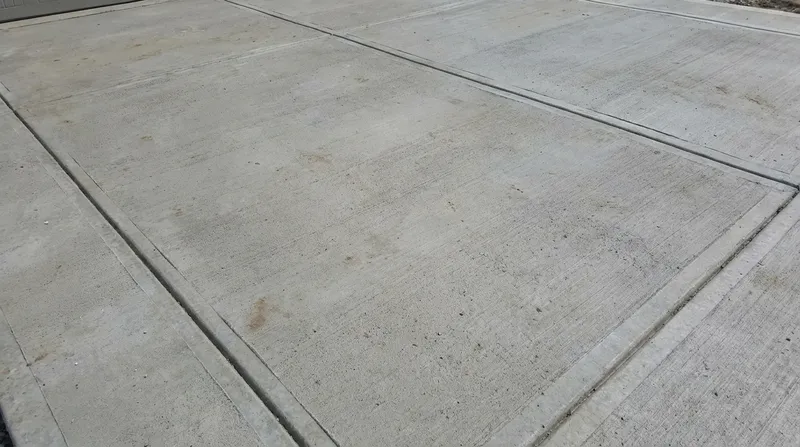
| Control joints | Cut 4–12 hours after finish, 1/4 slab depth, 10–12 ft spacing | Pre-decided cracks. All concrete cracks; joints choose where |
| Curing | ASTM C309 cure-and-seal sprayed the same day | Holds moisture in so the surface develops full hardness |
| Drainage | Crowned or sloped a minimum 1/4 inch per foot away from the house | Standing water at an edge undermines the base faster than traffic wears the top |
Every one of these is written into your scope before the pour, not decided on the morning of.
Concrete Driveway Finish Options
Broom Finish
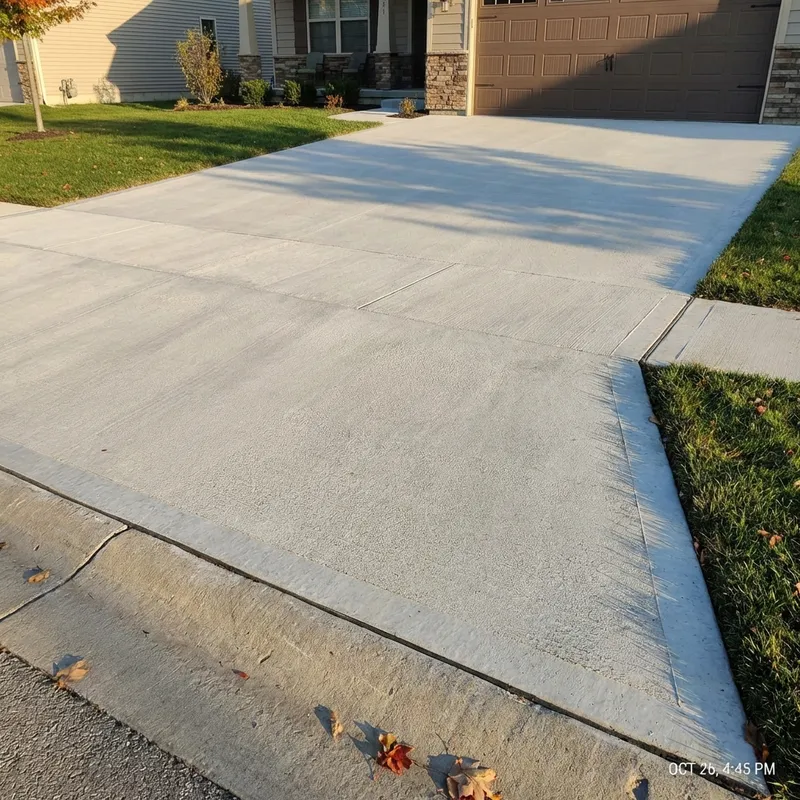
The default, and the right answer most of the time. A soft-bristle broom drawn across the surface leaves fine ridges that give tires and shoes grip when the driveway is wet. It hides minor imperfections, it costs nothing extra, and it does not need sealing to look correct. Included in the $9 to $13 per square foot.
Exposed Aggregate
The top paste is washed off while the concrete is green, leaving the stone standing proud. Excellent traction, no maintenance beyond a reseal every few years, and it reads warmer than gray concrete against brick. $12 to $17 a square foot. This is what we recommend in older neighborhoods where new gray concrete looks out of place.
Stamped and Colored
Integral color plus a stamped pattern, $16 to $24 a square foot. Understand the commitment before you buy it: a stamped driveway needs resealing every two to three years or the pattern goes chalky and the color fades unevenly. If nobody in the house will do that, pick a different finish. See our stamped and decorative concrete page for the pattern range.
Banded and Saw-Cut Borders
A stamped or colored border around a broom-finish field. You get the visual break where it is actually visible — the edges — at a fraction of a fully stamped driveway. Typically adds $1,200 to $2,600 on a standard two-car drive, and it lets you put the maintenance burden on a narrow strip rather than the whole surface.
Driveway Failures Caused by Huntsville Ground Conditions
Three things under this valley decide how a driveway ages, and none of them are the concrete. The first is shrink-swell clay. It takes on water — North Alabama gets more than 54 inches of rain a year — expands, then contracts through a dry August. A slab sitting on it is riding a slow-motion wave.
The second is limestone. Madison County is karst terrain, which means caves and voids in the bedrock are ordinary rather than unusual. Uniform settling across a whole slab is a base problem. One corner dropping sharply while the rest stays flat is often a subsurface problem, and pouring over it just sells you the same failure twice.
The third is water where nobody looked for it. We have re-poured driveways twice under warranty before anybody thought to check a leaking water service line washing fines out from under the base. Now it is the first thing we ask about when a section settles on its own.
None of that is fixed by a better bag of cement. It is fixed by digging, compacting, and knowing which failure you are looking at before you quote.
Concrete Driveway Cost in Huntsville — Real Numbers
These are 2026 installed prices for the Huntsville area, including demolition and haul-off of the existing driveway. Your written estimate follows an on-site measure, and it will land inside these ranges unless something unusual is going on with access or grade.
| Driveway | Approx. size | Installed range |
|---|---|---|
| Single-car, broom finish | 300 sq ft | $2,700 – $3,900 |
| Two-car, broom finish | 600 sq ft | $5,400 – $7,800 |
| Two-car with turnaround | 900 sq ft | $8,100 – $11,700 |
| Two-car, exposed aggregate | 600 sq ft | $7,200 – $10,200 |
| Two-car, stamped and colored | 600 sq ft | $9,600 – $14,400 |
| Broom field with stamped border | 600 sq ft | $6,600 – $10,400 |
| RV pad, 6 inches | 400 sq ft | $4,400 – $6,000 |
| Driveway extension or apron only | 150 sq ft | $1,350 – $2,100 |
| Small pad, patch or single step | under 80 sq ft | Call — we quote these |
There is no minimum job size. Small work carries the same mobilization and minimum concrete order as a big pour, so the rate per square foot runs higher — but we take it, and you get the number on paper before you agree to anything. If you have been told elsewhere that your job is too small, call us.
Concrete Driveway Installation Process
1. Measure and Written Scope
We walk the site, shoot elevations, check where water currently goes, and confirm truck access. The written scope arrives within 48 hours with the thickness, mix, steel, base depth and joint plan spelled out.
2. Demolition and Haul-Off
The old driveway comes out in full. We break, load and haul it — no burying broken concrete under the new pour, which is a real shortcut that a real number of crews take.
3. Subgrade and Base
Soft spots and old utility trenches get dug out and rebuilt. Then 4 inches of crusher run goes down in two lifts with a plate compactor over each. This is the step that decides the next twenty years and it is the step nobody photographs.
4. Forms, Grade and Steel
Forms are set to a crown or a minimum quarter-inch-per-foot fall away from the house. #4 rebar goes in on an 18-inch grid, tied at the intersections and chaired so it sits mid-slab rather than lying in the dirt.
5. Place, Finish and Cure
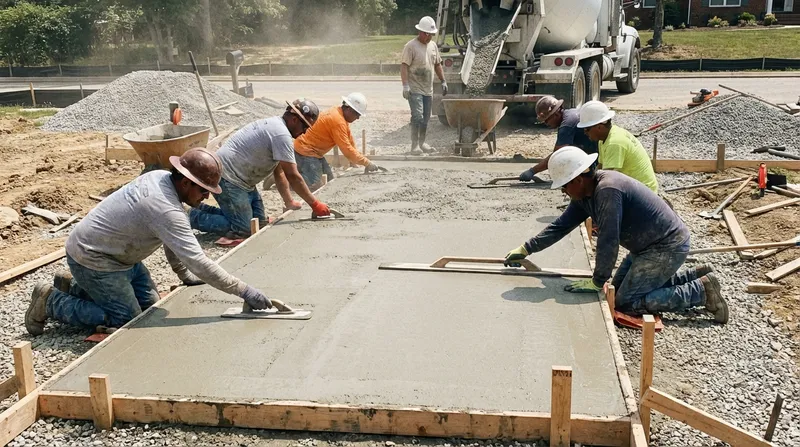
4,000 PSI air-entrained concrete placed at a 4 to 5 inch slump. Screed, bull float, edge, then broom once the bleed water is gone — brooming too early is how you get a weak, dusty surface. Cure- and-seal goes on the same day.
6. Saw Cutting and Handover
Control joints get cut 4 to 12 hours after finishing at a quarter of the slab depth. You get the cure dates in writing, the barricades stay up, and we come back to pull them.
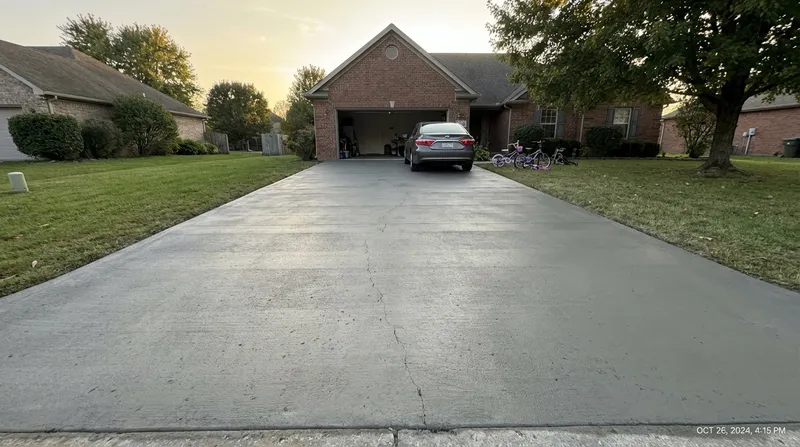
Driveway Replacement or Repair? How We Decide
Not every tired driveway needs tearing out, and we lose work saying so. If the concrete is structurally sound and has simply settled, polyurethane slab jacking runs $650 to $2,400 and lifts it back to plane — against $5,400 to $7,800 to replace. That is the honest answer even though it is the smaller invoice.
Replacement is the right call when the slab is cracked into more than three or four pieces, when panels have separated vertically enough to catch a shovel, when the surface is spalling across large areas, or when the driveway was poured too thin to begin with. At that point you are paying to maintain a slab that has run out of structure.
Cracks alone are not a verdict. All concrete cracks — the question is whether it is a hairline shrinkage crack, which is normal and not warranted by anybody honest, or a working crack with movement across it. We can tell you which one you have on the measure visit. More detail on the concrete repair and restoration page.
Other Concrete Work We Do at the Same Property
Patios and Walkways
Most driveway jobs come with a front walk. Pouring both at once shares mobilization and the truck order, which usually saves a few hundred dollars.
Concrete Repair and Restoration
Slab jacking, crack routing and resurfacing when the driveway has settled but the concrete itself is still sound.
Garage and Shop Slabs
Five-inch slabs with a 10-mil vapor barrier for garages, workshops and detached buildings at the same address.
Concrete Driveway Questions Huntsville Homeowners Ask
How thick should a concrete driveway be in Huntsville?
Five inches. ACI 330R allows 4 inches for typical residential use, and plenty of contractors here pour exactly that because it is the cheapest legal answer. The problem is the ground: Madison County clay swells after a wet week and shrinks flat in August, and a 4-inch slab has very little ability to bridge a soft spot when it does. The fifth inch adds roughly 12% to the concrete cost and roughly doubles the slab's stiffness. On RV pads and anywhere a loaded truck turns, we go to 6 inches.
Do I really need rebar, or is fiber mesh enough?
You need rebar. Fiber does one job well, which is controlling plastic shrinkage cracking in the first 24 hours. It does nothing for structural load and nothing for keeping the two sides of a crack in the same plane. That second job is what actually decides whether a driveway looks fine at year fifteen or has a lip you catch a snow shovel on. We run #4 rebar on an 18-inch grid, tied at the intersections and chaired up so it sits in the middle of the slab, not on the dirt.
How much does a concrete driveway cost in Huntsville, AL?
$9 to $13 per square foot installed, including tear-out of the old driveway and haul-off. A typical two-car driveway is around 600 square feet, so $5,400 to $7,800. What moves you within that range is how much old concrete has to come out, whether the truck can back in or we need a pump, and how much grade correction the site needs. We measure before we quote and the written scope follows 48 hours later.
How long before I can drive on a new concrete driveway?
Ten days for passenger vehicles and 28 days before a moving van, a dumpster, an RV or a loaded delivery truck touches it. Concrete gains strength on a curve that flattens at 28 days, and Alabama heat does not move that date forward — if anything, hot weather cures the surface faster than the core and makes early loading worse. You can walk on it at 24 to 48 hours. We leave barricades up and the dates in writing so nobody has to guess.
Why did my last driveway crack in a straight line across the middle?
A dead-straight crack almost always means a utility trench. When a line gets run, the trench is backfilled with the same loose spoil that came out of it, and unless somebody compacts it in lifts, that strip stays soft. The slab above it eventually loses support in exactly that line. We have torn out driveways that failed twice in the same three places for this reason. The fix is digging the trench line back out, rebuilding it in compacted crusher run, and then pouring.
Should I seal a new concrete driveway?
Yes, but not right away and not with the wrong product. We spray an ASTM C309 cure-and-seal the day of the pour, which is a curing step rather than a long-term sealer. After 28 days, a penetrating silane or siloxane sealer is the one we recommend for driveways — it soaks in and repels water without leaving a film that turns slick when wet. Reapply every 3 to 5 years. Skip the glossy acrylic topical sealers on a driveway; they look great for a season and then peel where the tires sit.
Get a Written Driveway Estimate With the Specs on It
Same-day callback if you call before 3pm. On-site measure inside three business days. Written scope 48 hours after that.